A Timeline of Italian American Food
By Ian MacAllen on Wednesday, January 21st, 2026 at 6:37 pm | 823 views
The history of Italian American food begins with the arrival of Italian immigrants at the end of the 19th century. Escaping the poverty of southern Italy, the Italian immigrants brought a culture of cucina povera, the poor kitchen, that emphasized vegetables, legumes, and pasta. These migrants rarely ate meat in their hometowns, but their arrival in America, a bountiful nation where hard work and higher wages, allowed their diets began to shift toward the abbondanza, the abundance, of America.
These changes were reflected in the dishes they developed and embraced in America, and laid the foundation for Italian American cuisine. Since few of these immigrants had enjoyed expensive foods, restaurants, or hotel kitchens before leaving Italy, the dishes they created were strongly influenced by the imagination of what those meals looked like. Another influence was the celebration of family. They had left behind families, wives, and children. Over time, as they found success in the United States, they sent for their families to join them, and reunited, celebrated with food. Celebration meals became much more common, especially on Sunday afternoons when multigenerational families gathered together.
Cities like New York, Boston, Chicago, Rochester, Buffalo, Pittsburgh, and anywhere low cost, hard labor was needed, Italians settled. Often neighbors consisted of other immigrants from the villages they left behind in Italy, and block by block, each enclave preserved the traditions of the towns they left behind.
Italian American Becomes American
By the middle of the 20th century, the foreign, ethnic food of Italian immigrants had grown in popularity in America. Italian American food was going mainstream. Not only were Italian restaurants the trendiest places to eat at, but fast food chains were serving pizza and spaghetti, and processed foods were filling grocery store shelves.
Then in the late 1970s, Italian American food traditions fell out of favor as consumers sought out contemporary Italian cuisine. Food in Italy had changed. The shortages of the war and the boom years of the 1960s had changed Italian cuisine forever, and it had never looked more different than the old traditions maintained by Italian Americans. Consumers sought “authentic” and “northern” cuisine, a shift that continued into the 21st century.
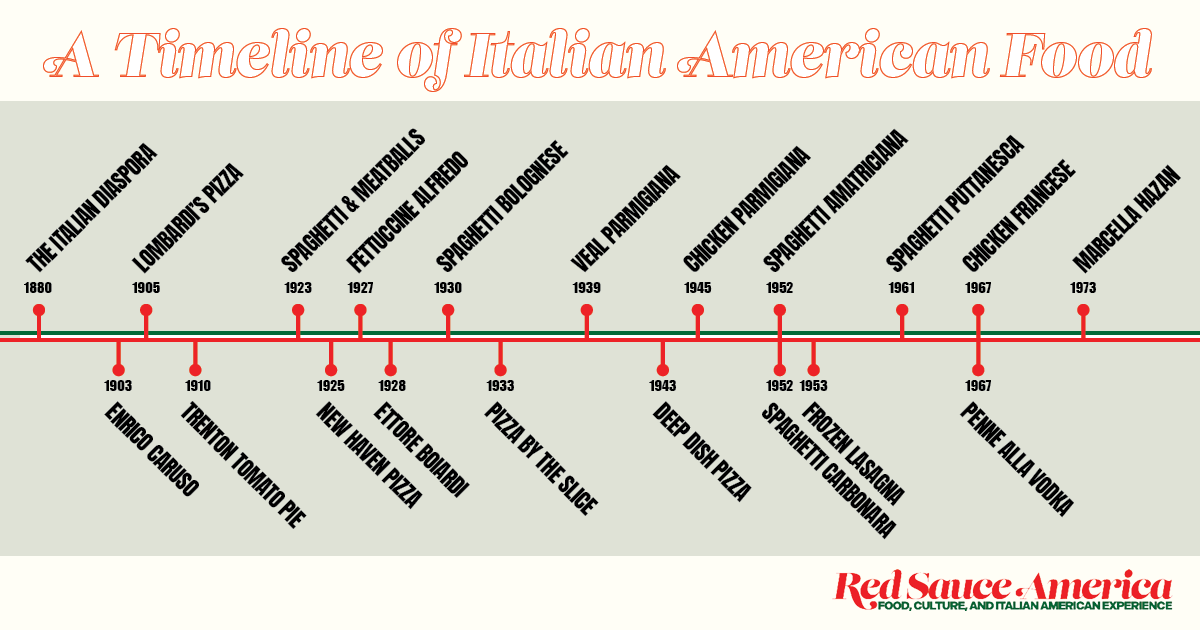
A Timeline of Italian American Food

Southern Italians emigrated to countries around the world in the 19th century setting in places like Argentina and the United States. Between 1876 and World War I, more than 500,000 Italians arrived in the United States

Italian opera singer Enrico Caruso was as famous as any pop star is today. Americans of all sorts followed his career, and he played a critical role in popularizing Italian American cuisine. He frequently dined at Del Pezzo in midtown Manhattan where his favorite dish of pasta with chicken livers and mushrooms was named Spaghetti alla Caruso, a dish that was popular through the middle of the 20th century. However, Caruso also lived in the Knickerbocker Hotel, and the chef there, Louis DeGouy, insisted the recipe did not have chicken livers.

Between 1905 and 1908, Lombardi’s, a grocery store, began selling pizza in New York City. It’s often credited with being the first pizzeria in the United States, but there’s evidence to suggest pizza could be purchased at a few other places around the city before that time. Lombardi’s did have an outsized influence over other pizzerias in the city, like Totonno’s and John’s of Blecker whose founders worked at Lombardi’s.

Joe Papa’s opens in Trenton sometime between 1910 and 1912 (the dates are disputed) selling tomato pie where the sauce is on top of the cheese. Joe Papa’s had claimed to be the longest operating pizzeria in America since Lombardi’s had closed for more than a decade, changed locations, and reopened with new owners. However, it has since closed.

American Beauty macaroni begins advertising pasta in The Macaroni Journal depicting meatballs and spaghetti together on the same plate in the Italian American way.

Frank Pepe opened Frank Pepe Pizzeria Napoletana in New Haven, Connecticut, launching a longstanding debate as to whether New York or New Haven style pizza is better.

George Rector published a column featuring Fettucine Alfredo in the Saturday Evening Post. Later that year, Hollywood stars Douglas Fairbanks Jr. and Mary Pickford visit Rome and befriend Alfredo Di Lelio, the chef behind the dish. The couple brought the recipe back to California and helped popularize the dish.

Better known as Chef Boyardee, Ettore Boiardi opened his first canning plant for jarred spaghetti sauce. Boiardi owned the Cleveland, Ohio restaurant, Il Giardino d’Italia where customers frequently requested sauce to take home, which he provided to them in old milk bottles. His factory launched an entire line of readymade pastas, and eventually many of his canned products would be distributed to soldiers during World War II.

Ragù alla bolognese is always served with tagliatelle pasta in Italy, but in the United States, “spaghetti Bologneze” became a popular dish in New York City restaurants like Ralph’s and Moneta’s.

Patsy Lancieri opened Patsy’s in East Harlem, the first pizzeria to sell New York pizza by the slice rather than by the whole pie.

Diane Ashley’s recipe collection, Where to Dine in Thirty-Nine lists recipes from a variety of New York City restaurants, including Veal “Parmiggiana” served at Pietro’s in Manhattan. The dish was probably created before 1939, but Ashley’s collection was printed that year. The recipe calls for liberally covering the cutlet with parmesan cheese — but doesn’t include mozzarella.

Pizzeria Riccardo, which would become Pizzeria Uno in 1955, started serving deep dish pizza in Chicago. It was at first an unremarkable contribution to the numerous Chicago pizza styles and the business almost failed in part because of the long cooking times. Recipe revisions improved the dough, and by 1956 a second location, Pizzeria Due had opened down the street. Other Chicago style pizzas include the thin tavern style and an a crispy caramelized crust invented but Burt Katz, but Deep Dish remains synonymous with the city.

Just across the East River, Pasquale Bamonte claims credit for inventing chicken parmigiana at his restaurant, Bamonte’s, in Williamsburg. Supposedly he ran out of eggplant while making Parmigiana di Melanzane. A local baseball team had come in, and to satisfy their requests, he swapped in chicken. This is of course, 6 years after Veal Parmigiana was being served in Manhattan.

Armando’s restaurant in Chicago adds spaghetti carbonara to its menu, with a local guidebook recommending the dish. However, other chefs have claimed credit, like Renato Gualandi who said in an interview he invented the dish in World War II for a banquet held in honor of the British and American commanders. Other mythologies attribute the dish to American soldiers cooking with their army rations in war torn Italy. More likely, the term Carbonara is a new name for an old dish.

The Rome Zoo had a two-year-old elephant named Remo that zookeepers often fed spaghetti al Amatriciana, a regional dish of Rome. Unfortunately, Remo passed away from a stomach infection thought to have been brought up by too much pasta. The newswire story was published in the United States across the whole nation, and helped make Amatriciana a well-known dish.

Stouffer’s began factory production of frozen foods like lasagna, first in Cleveland, Ohio and by 1956, nationwide. The pre-cooked frozen lasagna helped popularize the dish with non-Italians. About this time, women’s magazines had pronunciation guides to teach Americans how to pronounce “lasagna.”

Commonly, and incorrectly, known as a prostitute’s pasta, spaghetti alla puttanesca was likely created in the 1950s on the Island of Ischia. But it was the 1961 Italian novel, I>Ferito a
morte, by Raffaele La Capria, where the term puttanesca was first used for a pasta dish.

Italian chef, Armando Mei, working in his midtown Manhattan restaurant, created a sauce that combines tomatoes, cream, and vodka and served it with penne. Other chefs have claimed credit for the dish, but the Daily News described it as “never before served in an Italian restaurant.”

James J. Cianciola, known as Chef Vincenzo, made veal Francese famous at his Brown Derby restaurant in Rochester, New York. But by the 1970s, animal activists upset over veal consumption had turned the public against the meat. The Brown Derby solution was to use chicken. Cianciola didn’t just “French” chicken, but used the technique on many other foods in the restaurant, and eventually he released an entire cookbook with recipes from “Frenching” foods.

Italian-born Marcella Hazan publishes her first recipe collection, The Classic Italian Cook Book. The bestselling recipe collection is often compared to Julia Child’s Mastering the Art of French Cooking. Hazan followed up with a second volume, and then combined both books into Essentials of Classic Italian Cooking
Hazan’s recipe collection focused on contemporary Italian cuisine, and created a desire for dishes that eschewed Italian American cuisine in favor of “authentic” and “northern” style cooking. For a full look at Hazan’s impact in American, check out the documentary by Peter Miller, Marcella
Italian American Cuisine in the 21st Century
There continues to be an interest in replicating dishes from Italy, and especially emphasizing regional cuisines from Tuscany, Liguria, and Rome. However, the classic red sauce of Italian American tradition is also enjoying a renaissance.
Restaurants like Carbone and Don Angie are reinvigorating red sauce and reinterpreting classic dishes in new ways. And few restaurants would dare have a menu without including meatballs. The craze for Neapolitan style pizza too appears to be waning with newer pizzerias celebrating the New York, New Haven, and Detroit style slices.
Meanwhile, the husband and wife team behind Don Angie also produced a celebrated cookbook, Italian American, highlighting many of their new takes on old classics. Other Italian American traditions like the Feast of the Seven Fishes has grown in popularity capturing the zeitgeist of average Americans.
The Red Sauce Story
This timeline of Italian American food is only part of the story. How these dishes were created, and evolved in the United States, is a complex one filled with myth making and invented stories. For the full story, check out Red Sauce: How Italian Food Became American, a look at the evolution of the cuisine from the origins in Italy to the modern Americanized dishes.